Junior → Mid → Senior DevOps: What Actually Changes
An honest breakdown of how DevOps growth really happens—from execution to system design to prevention—beyond tools, titles, and hype.
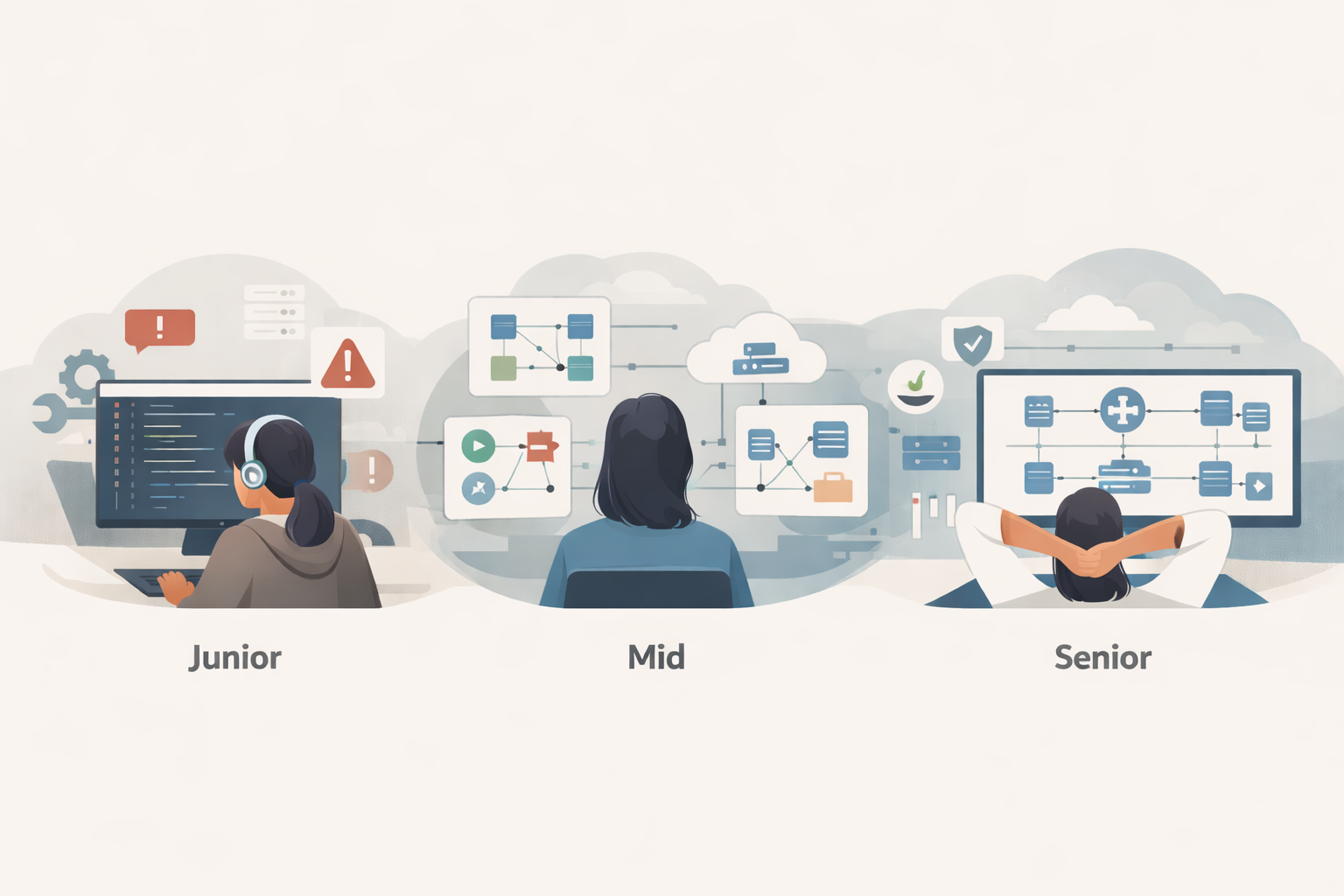
Table of Contents
Most people think DevOps growth looks like this:
More tools → more complexity → higher title
That’s not how it works in practice.
What actually changes is how you think, decide, and reduce risk.
Let’s break it down honestly.
Junior DevOps: From Commands to Consequences
What you mainly focus on
- Running commands
- Following runbooks
- Fixing what’s broken after it breaks
- Learning tools: Linux, Git, CI/CD, cloud basics
You operate inside the system.
Typical questions you ask
- “What command should I run?”
- “Which YAML value fixes this?”
- “Why is this service not starting?”
Strengths
- Fast execution
- Willing to learn
- Good at reproducing known fixes
Blind spots
- You see symptoms, not systems
- You trust tools more than understanding
- You escalate quickly because blast radius feels scary
Value you provide
Hands-on execution
You reduce toil by doing what others already know should be done.
Mid-Level DevOps: From Fixing to Designing
This is the most misunderstood stage.
You don’t magically become “senior” by adding Kubernetes or Terraform to your résumé.
What actually changes
- You start seeing patterns
- You fix root causes, not just alerts
- You design workflows, not just pipelines
You operate across the system.
Typical questions you ask
- “Why does this keep failing?”
- “How can we make this harder to break?”
- “What happens if this component goes down?”
Skills that matter here
- Debugging across layers (app → OS → network → cloud)
- Writing automation that others can safely use
- Making trade-offs (speed vs safety, cost vs resilience)
New responsibilities
- Owning services end-to-end
- Improving reliability metrics
- Reducing operational noise
Value you provide
Stability and leverage
One improvement you make saves dozens of future incidents.
Senior DevOps: From Building to Preventing
This is where most people get it wrong.
Senior DevOps engineers do less visible work, not more.
What actually changes
- You think in failure domains
- You design guardrails instead of hero fixes
- You prevent incidents that no one knows almost happened
You operate above the system.
Typical questions you ask
- “What assumptions are we making?”
- “What’s the worst possible failure here?”
- “Who gets paged if this breaks at 3 AM?”
Senior-level behaviors
- You remove complexity instead of adding tools
- You push back on unsafe changes
- You influence architecture without owning every line of code
Tools matter less
At this level:
- Terraform is expected
- Kubernetes is assumed
- CI/CD is table stakes
Your differentiator is judgment.
Value you provide
Risk reduction at scale
You quietly make the system boring—and boring systems survive.
The Real Progression (Side-by-Side)
| Level | Focus | Scope | Core Value |
|---|---|---|---|
| Junior | Execution | Single task | Speed |
| Mid | Design & patterns | Service/system | Stability |
| Senior | Prevention | Org-wide | Safety & leverage |
What Doesn’t Change (But People Think It Does)
❌ Titles ❌ Tool count ❌ Fancy architectures ❌ Being on-call 24×7
Those are side effects, not growth signals.
The One Question That Defines Each Level
- Junior: How do I fix this?
- Mid: Why does this break?
- Senior: How do we make this hard to break at all?
If you want to grow, don’t chase tools.
Chase clarity, system understanding, and irreversible proof:
- a postmortem that prevented repeat failure
- an automation that removed human risk
- a design decision that reduced blast radius
That’s what actually changes.
